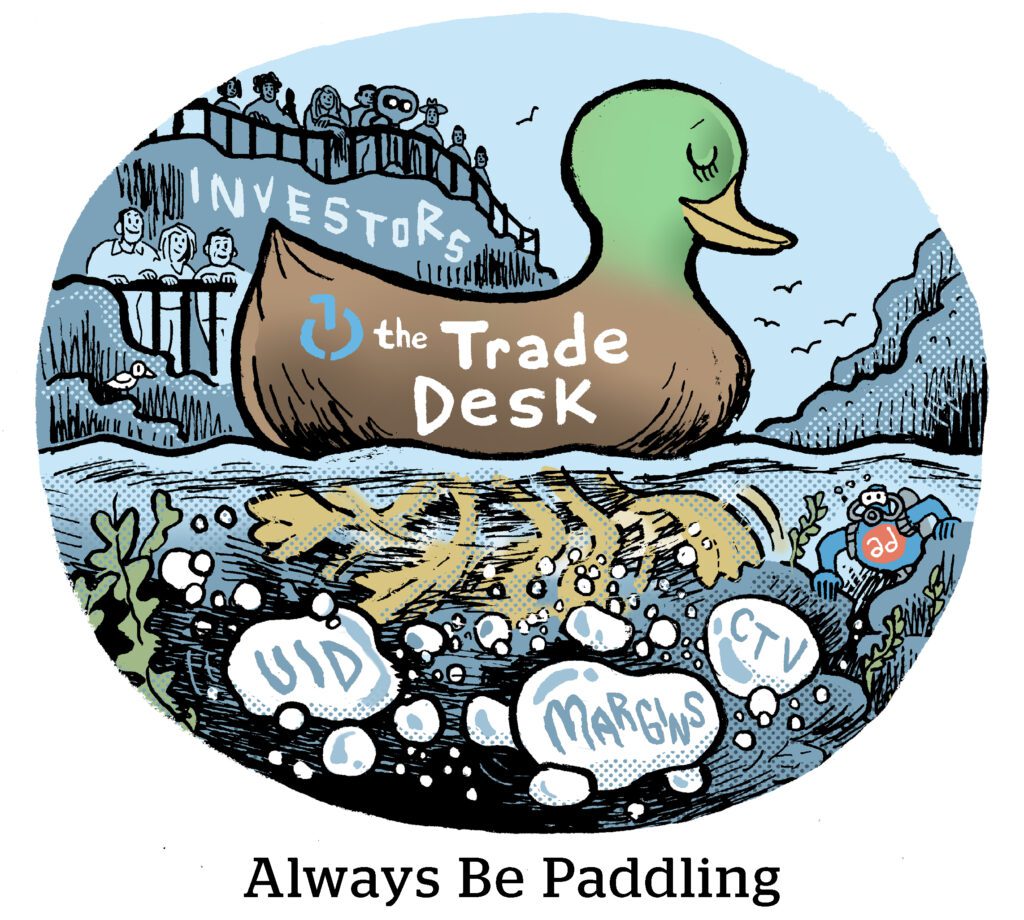
The Trade Desk, a longtime darling of Wall Street and programmatic, is back at square one in terms of convincing investors of the value of an independent DSP and kindling goodwill in the ad tech industry.
The company reported Q4 and full-year 2025 earnings on Wednesday. TTD’s revenue grew 14% year over year to $847 million, though CEO Jeff Green noted that the growth rate was 19%, excluding the political ad budgets from Q4 2024. Its profit from the quarter was $187 million, which ticked up by $5 million from Q4 2024.
Investors were discouraged by the earnings report, with shares dropping by about 10% overnight.

TTD attributed the headwind primarily to weakness in two key categories – automotive brands and, especially, in the CPG and grocery brand sector. The company also issued a revenue forecast that calls for only 10% year-over-year growth in the current quarter, which means TTD’s growth rate is trending down quickly. The company grew at a 26% clip in 2024, followed by 18% growth last year. The Q1 2026 forecast coming in at 10% continues a worrisome trend for investors.
This is also the one time per year that The Trade Desk discloses its gross platform spend, which was $13.4 billion in 2025. That number allows investors (or reporters) to deduce TTD’s take rate, a healthy and steadfast 21.6%.
“There’s been a narrative that our margin or take rate must compress because other platforms offer lower upfront prices for non-decisioned, non-data-driven buying,” Green said.
But TTD has maintained a take rate of more than 20% even as CTV (a category with generally lower take rates for tech intermediaries) grows as a share of spend.
Macro problems
The auto and CPG verticals account for about one-fourth of The Trade Desk’s total ad spend, Green told investors.
Excluding that segment, TTD’s business grew by an extra 5% at least, he added.
But the pullback for those businesses is felt first and foremost by the marketing org. Leadership at those companies are dealing with “forces that are bigger than us and even bigger than them,” Green said.
In times of uncertainty, advertising is “often the thing that gets paused, that [businesses] would rather adjust marketing budgets than lay people off,” he said.
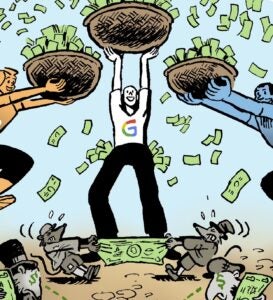
Amazon offers many of those types of marketers, CPGs and grocery brands in particular, an attractive deal in the form of a DSP with very low fees. But, Green argued, those are not independent DSPs. Google and Amazon are funneling those budgets to owned-and-operated inventory where the walled gardens earn more on the media itself.
He said these companies excel at claiming last-touch attribution credit, but that the result is like a kids’ soccer game, where a swarm of 5-year-olds all try to be the last one to touch the ball before it gets into the net. This is in contrast to a more mature approach, where the goalie, defense and whole team is credited accurately for their contribution even if the striker scores most of the goals.
This lack of objectivity by TTD’s main rivals is “more of a moat than a threat,” he said. “But it does create a higher burden for us to explain that to the world.”
Explaining to the world
The programmatic world is no longer eager simply to draft in TTD’s wake. Now, SSPs, DSPs and other ad tech companies are jockeying with TTD for position or taking a more head-on approach. And the narrative in market is that the DSP sector is being compressed due to the incumbency of Google and the ascendancy of Amazon.
One investor asked about reports of agencies dropping out of OpenPath, TTD’s direct-to-supply integration product that generally cuts out the SSP.
This is a “moment where many agencies are focused on principal-based buying, [and] I think not doing as good of a job of representing their clients as they could,” Green responded.
He is referring to the practice by agency holdcos of cutting direct deals with media companies for bulk inventory, which the agency resells to its clients at a higher profit rate than a typical campaign.
Agencies and SSPs are “convoluting the ecosystem more than they have in the past,” he said.
OpenPath charges publishers a 4.5% fee to integrate, which, Green said, is just above a break-even rate to support the initiative and should be the most cost-effective route to inventory for TTD advertisers.
Some agencies and SSPs or inventory resellers use business models, such as principal-based buying, that preserve greater margins for their respective businesses, rather than generating value for the advertiser.
Or that’s The Trade Desk’s angle, at least.
“I’m not surprised at all that OpenPath ruffles feathers and bothers people,” Green said. “I’m not surprised that some people would like to turn it off if they find ways to get paid in unique ways.”