Almost five years have passed since Google quietly introduced a beta product called Performance Max (PMax).
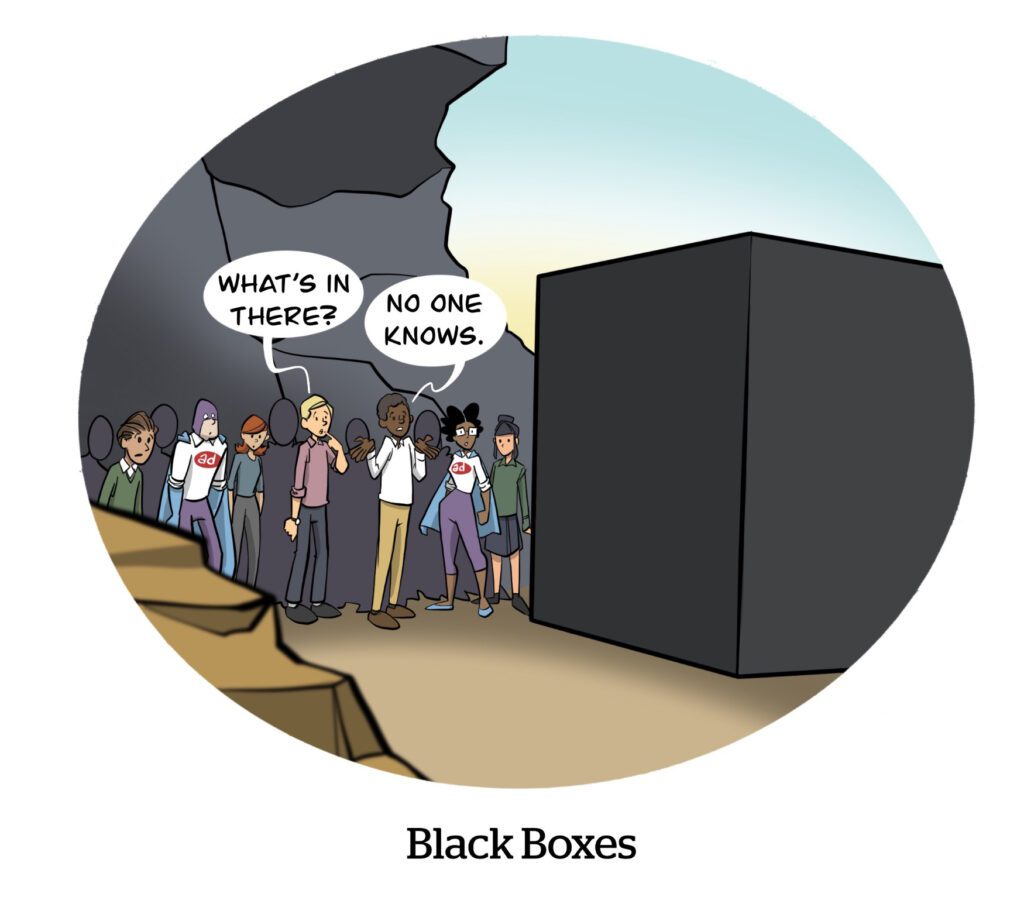
There are now more than one million advertisers using PMax, Google boasted in an announcement on Wednesday. But for many of those advertisers, it’s been five long years of screaming, flailing, cajoling and waving their arms about as they sought campaign reporting info from the black box.
Finally, it’s happening. Advertisers will soon be able to see around three of the most important transparency blockers in PMax: channel-level reporting, search terms reporting and creative asset reporting.
Google will open a beta program for channel-level reporting and will roll out the other updates for search terms and asset reporting over the course of the year, the company also announced on Wednesday.

Crossing the channel
What are these reports and why are they important?
Well, PMax serves ads across almost the entire Google media fleet (Search, YouTube, Gmail, Maps, Discover, Shopping Ads and the ad network). However, Google provided no visibility into where those ads served or how much had been spent on the placements that you can’t see. Advertisers also didn’t know what formats were used or which specific videos or product pages in a shopping campaign were performing well or poorly.
The channel-level reporting beta, which will launch after the Google Marketing Live event next month, shows granular stats on how many impressions were served to each channel in the PMax mix, Google Ads product director Tal Akabas told AdExchanger during a press roundtable prior to the announcement.
“You’ll be able to see the number of impressions, the number of clicks, the number of conversions from each of those channels, as well as cost,” Akabas said.
Getting the cost visibility is a key win, too, because even while PMax had cracked open slightly to reveal some ad placements and format types, it has never revealed the spend breakdowns between different channels.
For example, advertisers might have been able to glean some PMax ads serving to YouTube and other channels. But it was a jury-rigged and inconsistent way to reveal which video ads were served by PMax, because it’s hacked together by vendors rather than clearly reported by the Google platform.
The channel-level reporting in beta will disclose where those ads were served. And the new asset reporting shows which specific video assets were used in a PMax campaign, while retailers will be able to see which products from their catalogue were pulled by PMax, which is another important bit of information they had with their manual shopping campaigns.
Searched and found
Another long-running PMax transparency controversy is its search reporting. PMax’s pitch has partly been that Google AI can find new search keywords and pockets of growth. For instance, if a museum has great activities for kids, the PMax algo might sniff that out, steer search ads toward child care-related search terms or things to do for parents, write new ad copy and run a whole campaign along those lines. And the museum might not even know it’s happening.
One of the earliest PMax transparency concessions was for branded search. Advertisers were rightly horrified by PMax’s initial search tactics, because it bought branded search terms (the company’s own name and products) and thus could cheaply self-attribute purchases that were about to happen anyway.
Even with controls to block PMax from targeting certain terms, advertisers still didn’t have the same visibility as they do with their own standalone search campaigns. The new search terms reporting, though, which also goes live after Google Marketing Live, will create parity between the campaign reports an advertiser sees using their own single-channel Google Search campaigns, Akabas said.
Why not always?
PMax has had to negotiate an awkward growth spurt.
It needed to demonstrate to advertisers that Google’s machine learning could produce superior and reliable results based on the business’s stated outcomes. But to do so, it’s had to push advertisers into new channels, placements and formats they wouldn’t think of or might even explicitly avoid if the human ad buyer was at the controls.
“We really wanted Performance Max to be the place that advertisers could go to branch out from just buying by single channel and see how those channels could work together to deliver maximum performance,” Akabas said.
The lack of transparency with PMax has no privacy rationale, like how advertisers are losing visibility into cookies, device IDs and IP addresses in many channels. But Google must balance how much info to give advertisers without them ditching the product while seeing results to justify the spend.
“We didn’t want to release the granular stats without any explanation, because our worry was it would either be misinterpreted or advertisers wouldn’t know what to do with it,” as Akabas put it. PMax has focused instead on adding back reporting info “within the context of how it drives your business objectives and diagnostics, so that advertisers feel like they’re in control to some extent,” he said.
If these PMax updates remain on track, then before next year advertisers should have near parity between the channel-level information reported by PMax compared to their standalone, single-channel or human-controlled campaigns.
“Advertisers want to see both the raw data as well as the inputs [made by Google’s machine learning],” Akabas said. “We try to offer both where it makes sense.”