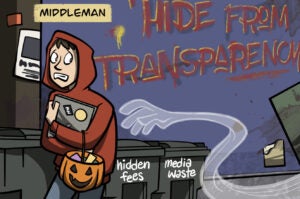

Every conversation about addressability eventually lands on the same word: fragmentation. But the real symptom of that fragmentation isn’t just operational complexity; it’s also declining match rates. That single number explains why marketers are struggling to make their data work.
Match rate is the percentage of users you can actually recognize and reach when data moves between systems, from onboarding to activation to measurement. And it’s getting worse. According to a recent study from Go Addressable, CIMM and Truthset, IP match rates are dismally inaccurate, with IP-to-email matches accurate only about 16% of the time on average.
The industry’s signal loss problem is actually a match rate problem, and it’s costing advertisers scale, accuracy and efficiency.

The cost of too many partners
Here’s the uncomfortable truth: The more partners you involve, the lower your match rate will be. Every handoff between systems creates another sync point, another data loss event.
The industry has increasingly focused on supply-chain optimization, reducing intermediaries, cutting inefficiencies and streamlining media flows. Yet, while media supply chains are being optimized, match rates have been largely neglected. The industry has simply accepted the status quo.
When a brand onboards its data, it often passes through multiple ID systems: emails, cookies, device IDs, DSP identifiers and publisher IDs. Each translation creates friction and sacrifices a portion of the audience. What started as a strong first-party file ends up reaching only a fraction of its potential audience.
Fewer hops, higher match rates
Solving this problem requires more than supply-chain simplification; it demands identity optimization. Offline data onboarding, cross-device activation, measurement and planning all depend on consistent, high-quality identifiers.
Privacy regulation adds another layer of complexity. GDPR, CCPA, LGPD and APPI all define personal data and consent differently. Yet most identity providers haven’t built the legal and technical infrastructure to navigate these differences across jurisdictions.
A unified partner with global coverage, privacy compliance and end-to-end control of the graph and activation layer keeps your data connected, maximizes match rates and ensures campaigns deliver measurable impact.
One identity layer
This is why ID5 acquired TrueData: to improve match rates and reduce fragmentation by unifying a comprehensive identity graph with the most scaled alternative ID. The graph connects signals across devices, households, partners and channels, providing continuity and accuracy.
The ID5 ID then carries that unified identity through the bidstream, making it actionable for activation and measurement. Together, they preserve more audience throughout the campaign life cycle.
This is visible across common use cases, including:
Offline data onboarding: The graph translates more signals between systems, while the ID ensures those matches persist across platforms, turning a larger share of first-party data into addressable reach.
Cross-device activation: The graph links devices and channels, and the ID maintains recognition as insights move from mature, data-rich environments such as the web into CTV or gaming, enabling scale without duplication.
Measurement and planning: The graph allows efficient connection to conversion data, while the ID ensures the same user is recognized at the impression and outcome level. This allows results to be attributed reliably, even when signals are limited on the converting device.
Identity only delivers value when it’s built on an end-to-end connection. By maintaining that link while respecting consent and data protection standards, the industry can preserve reach and continuity, so that more of the audience stays addressable and performance can be measured reliably across channels.
For more articles featuring Mathieu Roche, click here.