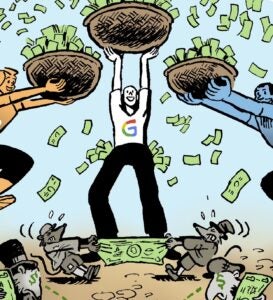
Conversations around publisher revenue have been gloom and doom over the past couple of years. But here’s a bit of good news: The Guardian US grew its programmatic revenue by 44% year over year in February.
That’s an outlier in a market where many publishers are grappling with AI-driven shifts in search behavior and stubbornly flat open-auction CPMs. But the Guardian US didn’t get this revenue bump by chasing more pageviews; the lift came from higher effective CPMs across both the open exchange and private marketplace deals.
“Revenue was up more than 40% year over year in February, and none of that was driven by traffic,” said Dave Strauss, VP of Revenue Operations & Strategy. “The lift is coming from CPMs, both in the open auction and through PMPs.”

CPMs, not clicks
While the Guardian US hasn’t been hit as hard by AI-related traffic disruptions – Strauss said the publisher has been “lucky” given its news-heavy content – the February results were driven squarely by pricing, not volume.
“It’s very much a rising-tide effect,” he said. “As we lean into PMPs and curated marketplaces, that demand helps support pricing in the open auction.”
Behind that lift is a quieter operational shift. Over the past year, the Guardian US rebuilt its programmatic operations around daily data and real-time monitoring. Teams closely track performance, CPMs and supply-path health, with alerts that flag issues immediately instead of days later.
“We’ve become a purely data-driven business,” Strauss said. “Every day, we’re tracking programmatic performance, and if something breaks, the right teams get alerted immediately.”
For publishers that have leaned on traffic gains to offset programmatic headwinds, the Guardian US offers a different playbook: Focus less on volume and more on the value of each impression.
From cheap reach to signal-rich media
That approach reflects a broader shift on the buy side.
For years, programmatic was treated primarily as an efficiency channel, especially in categories like food, beverage and big-box retail. Programmatic was a way to hit reach and frequency goals at the lowest possible cost. That often meant leaning into the long tail and made-for-advertising (MFA) inventory.
That mindset is starting to change, said Zack Kleinman, head of programmatic and retail at the Guardian US, as brands reassess the trade-offs between cost, quality and performance.
“In those categories, programmatic isn’t treated as just an efficiency channel anymore,” Kleinman said. “Brands want to connect their brand and retail media budgets into one strategy, and programmatic is often the connective tissue.”
The Guardian US is positioning its inventory accordingly – not just as “premium” in the traditional sense but as signal-rich and trusted. The focus is on private marketplace deals and curated packages that offer clear context, stronger signals and less friction for buyers.
In practice, that means building straightforward packages around key environments, such as brand-safe news, sports tentpoles and commerce content. Then, you layer in contextual and identity signals that help buyers optimize toward outcomes.
“Buyers are stretched really thin,” Kleinman said. “They don’t want a complicated menu of options. They want packages that are easy to turn on in their DSP and that send the right signals so they can optimize.”
Vertical strategies sit on top of that structure. For retail and commerce advertisers, for example, the Guardian US leans into purchase-intent signals from its affiliate and service journalism content to better connect upper-funnel storytelling with lower-funnel influence.
“Premium starts with trust and runs through the entire transaction,” Kleinman said. “It’s not just about where the ad runs, but whether that environment, the audience and the supply path actually improve performance.”
Tightening the pipes
Under the hood, the Guardian US has also been reworking its supply paths.
Rather than spreading inventory across as many SSPs as possible, the team has become more selective by prioritizing partners and deal structures that make it easier for buyers to transact. The goal is to ensure the Guardian US inventory shows up clearly within the platforms and paths buyers already use, while sending as many relevant signals as possible along those routes.
“It’s not enough to say you offer programmatic; you have to be prioritized within the pipes buyers actually use,” Kleinman said.
That approach aligns with increased scrutiny from the buy side, where advertisers are pushing harder on supply-path optimization and demanding more transparency into fees and intermediaries. Cleaner, more direct paths make it easier for buyers to understand what they’re getting and more likely to pay a premium for it.
The broader question is whether this shift toward higher-signal, higher-priced inventory can consistently scale. After a decade of chasing the lowest CPMs, many advertisers are now trying to cut out low-quality supply while maintaining reach.
The Guardian US’s recent results suggest at least some buyers are willing to test that trade-off.