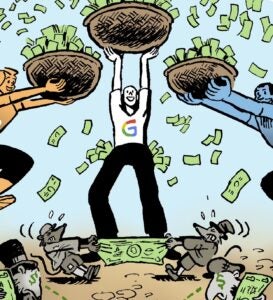
When buyers use The Trade Desk (TTD), they face a byzantine fee structure, including platform fees, tech fees, bid-shading fees, OpenPath inventory fees, data fees and measurement fees.
On this week’s podcast, we speak to Sarah Caputo, founder of consultancy Fraction Method, about her column in AdExchanger about The Trade Desk’s monetization structure. She argues that The Trade Desk should reduce its take rate and make fees more transparent. Why? Advertisers weighed down with fees will see their media performance decline. An accrual of hard-to-parse fees mean buyers can’t pick what add-on fees work for their business needs.
Two fees, in particular, rankle. First, buyers’ default settings often include paying bid-shading fees (Predictive Clearing) to The Trade Desk whenever the DSP reduces a buyer’s maximum CPM in first-price auctions. So if the DSP says it bid a $4 CPM when the buyer could have been stuck with a $20 CPM, it will take a double-digit percentage out of that $16 CPM savings.
Second, the fee structures in Kokai’s newer “Performance” mode vs. “Control” mode require punishing trade-offs between keeping optimization control and reverting to a menu of add-on fees. There needs to be a middle ground, Caputo says.
Plus, why charge bid-shading fees at all when inventory goes through OpenPath, a TTD-owned pipe? There is no information asymmetry that requires the use of bid shading. Is The Trade Desk exacting savings when bidding against itself? Or just preserving its Predictive Clearing fee? The current setup doesn’t make sense, she says. “My feeling is that you own those pipes. Now what are you predicting in terms of CPM? You literally have access to all the data.”

The market is shifting to avoid this fee structure. The agencies WPP Media and Dentsu recently exited OpenPath over its fee structure and concerns about transparency. And the market-share-gaining Amazon DSP offers lower fees, including 1% programmatic guaranteed fees in some cases, that undercut the competition.
What The Trade Desk really needs to do is right-size its margins, Caputo says. If they lower their take rate, the performance will be more attractive to buyers and allow TTD to compete better with rival DSPs. Doing so will require growing revenue more slowly.
The Trade Desk predicts only a 10% growth rate, slower than that of the digital advertising market overall, so it might already be moving in that direction.
This article has been updated to more precisely describe the nature of some Trade Desk fees.