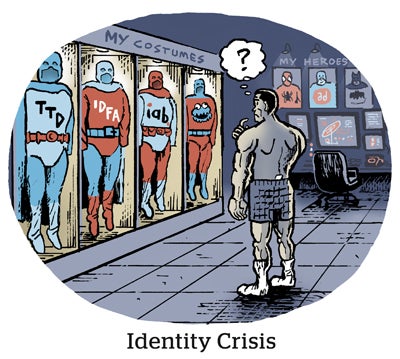
If you thought programmatic didn’t have room for yet another advertising ID graph, then you’d be wrong.
On Monday, PayPal launched the PayPal Ads ID, a new identity product tied to PayPal and Venmo’s customer base.
The most important thing to know about the ID, according to Dan Robbins, head of growth and strategy for PayPal Ads, is that it’s not a cookie standing in for identity and it’s not a device signal. It’s also not stitched together from a consortium of providers with a patchwork of mostly cookie-based identifiers.
So what is it then?
It’s an omnichannel identifier built entirely on PayPal’s and Venmo’s customers. Every profile in the graph is a user of at least one of its products with a credit card attached, Robbins told AdExchanger.

The other thing that distinguishes the ID from other programmatic ad IDs, he said, is that it’s available for free to any data or ad tech vendor that has a commercial relationship with PayPal Ads. There are no associated software fees, and PayPal isn’t taking a percent of media or charging based on CPMs or for data consumption or token usage.
The PayPal Ads ID also isn’t confined to PayPal’s own media. As long as an advertiser and ad tech intermediary is a PayPal Ads client, they can use the ID for buying any programmatic inventory.
Magnite, Rokt, Taboola and PubMatic are the initial PayPal Ads ID partners. So any advertiser that’s a PayPal client can use the new ID for free while using those platforms, according to Robbins.
“We are partnering with the ecosystem,” he said, “because we want to ultimately make ads more relevant and more performant.”
PayPal Ads clients and their partners can also augment or append data to the PayPal Ads ID when advertisers buy media through an SSP or publisher that’s integrated with the product.
PayPal has to extend its ID network through intermediaries and “augmentation” because, although its products have scale, they don’t reach everyone.
But although PayPal’s ID isn’t built on third-party cookies, many of those intermediaries rely heavily upon them.
For all the ballyhoo about diversification away from third-party cookies since Google first announced plans to remove them from Chrome (lol), top ID graphs – including LiveRamp’s RampID, The Trade Desk-backed Unified ID 2.0, Yahoo’s ConnectID and others – are still largely based on third-party cookies. And as long as third-party cookies are freely available, data collectors will hoover them up.
Against that backdrop, Robbins said, PayPal wants advertisers to compare how different ID graphs perform – including, of course, the PayPal Ads ID graph derived largely from its payment and credit card customers – rather than just looking at which ones appear to have more reach.
PayPal Ads, after all, “is not in the business of selling identity,” he said.
Rather, PayPal Ads is giving its ID graph to commercial partners and clients for free because, as Robbins put it, the “more platforms that have access to this commerce-grade identity, the more dollars [will move] into retail media as a category.”