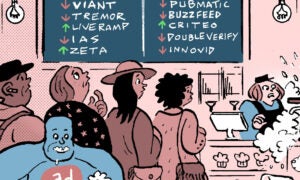

Viant reported its Q4 and full-year 2025 earnings on Wednesday evening, and investors appeared pleased.
Net income last year was $24.1 million, almost double the total in 2024. Full-year 2025 revenue, meanwhile, grew by 22% to $110 million. CEO Tim Vanderhook told investors that revenue would have grown 28% without the affect of the prior year’s election cycle, which boosted 2024 political ad sales and created tougher comps.
Viant shares jumped by more than 10% on Thursday.
One of the factors behind Viant’s strong earnings report is that it’s a relatively small company and thus can generate larger percentage-based growth than an incumbent like Google, Amazon or The Trade Desk.
Investors pressed Viant’s executives on whether it can sustain growth rates that outpace its larger competitors.

But investors also seemed to appreciate the feisty, aggressive-not-defensive posture of Viant’s sibling leaders, the aforementioned Tim Vanderhook (we’ll call him Tim V.) and COO Chris Vanderhook (Chris V).
Fighting with heavyweights
Laura Martin, a tech and media analyst at investment bank Needham, called out that Viant had a really good Q4 compared to a relatively anemic market for third-party programmatic tech.
That said, Wall Street investors tend to believe that large, global footprints are in an inherently better position than a smaller player like Viant.
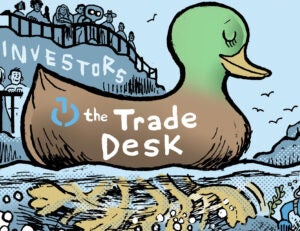
For example, in a relatively low-growth 2025, when The Trade Desk saw its market cap diminish, TTD still added $450 million in incremental revenue. That’s about four Viants.
Martin put it bluntly: “Convince me that ‘small’ can win at these much higher revenue growth numbers than Google and Trade Desk, who are globally scaled competitors in your direct business.”
According to Chris V., brand marketers are wising up to the largest platforms “self-reporting their own success,” generally with great ROAS numbers that don’t correlate to real-world sales and lift.
Amazon, in particular, is “definitely a threat,” Tim V. said later in the call.
“I don’t want to discount Amazon as a competitor in the space like some others have,” he said, in a fling at The Trade Desk.
Amazon has greatly subsidized its DSP by minimizing fees and fronting campaign or testing costs to buyers, Tim V. said. Amazon has also been “doing the bundling strategies that Google executed.”
From the advertiser perspective, the Amazon DSP is useful (if not required) for companies that sell on Amazon. But for a brand carried across, say, 50 retailers, Amazon “really isn’t a good fit,” he added.
Tim V. also cautioned big media companies about signing on with Amazon, since Netflix and Roku recently signed deals with the Amazon DSP.
“If Amazon runs the same playbook as Google,” he said, they’ll just claim that “Prime Video outperforms every other app on the buy.”
The AI hype cycle
But what’s an ad tech earnings call without talk of agents and AI? Viant says it’s all in on the agentic future.
It has a new LLM-based prompt and response interface, which is different from the standard self-serve UI, Tim V. said.
According to Viant, its outcomes-based AI optimization product, called “Outcomes,” has outperformed human media buyers across categories and conversion types. Even so, it’ll take time for buyers to get comfortable and trust that there aren’t hallucinations in the data or analytics, Tim V. said. “I hate to say old habits die hard, but people like to click buttons.”
Regardless, the age of the interface is over. “Overall, interfaces are dead,” he said. “Dashboards are dead.”
Instead, people will adopt the new AI-oriented systems, in part because they work better and partly because they’re easier to learn and use.
“You don’t need to go to Trade Desk Academy for two weeks and still make mistakes after that,” Tim V. jibed again at the 400-lb gorilla, which is known for its dashboard and UI investments as much as for its AI investments.
But Tim V. was also circumspect about the tangible returns on AI chatbot ads in the here and now.
Although The Trade Desk is reportedly in talks with OpenAI, the Vanderhooks believe DSPs aren’t intuitive partners with OpenAI on ads right now.
They pointed out that ChatGPT lacks the standardized OpenRTB inventory and data fields that, in effect, are programmatic advertising.
It “doesn’t really fit with the RTB protocol as we do,” Tim V. said.
However, Criteo, which is OpenAI’s first official third-party ad tech partner, makes more sense, he said, given its expertise at recommending product listings for a shopping query.
Tim V. cautioned investors not to get overly excited about ads in ChatGPT or other AI search engines until they know more about what the formats look like and what level of data will be shared.
“We are always a little slower in going to work with organizations like this, because we’re mindful that they may change strategy overnight, like you saw with agentic checkout with commerce transactions,” Tim V. said. “That has already been abandoned.”